From Fragmented Tools to a Connected Enterprise.
A fast-growing AdTech organisation had adopted Zoho One, a suite of 35 integrated business applications, without engaging a specialist to implement it. The configuration had changed hands at least four times before the engagement began. Each team had customised their assigned application in isolation, with no consideration for how it connected to the rest of the business.
The result was a fragmented ecosystem where no two applications spoke to each other. Employees across the organisation were maintaining personal spreadsheets alongside the system because the tools could not be trusted to hold accurate, consistent data. The spreadsheet had become the real system of record. The enterprise software was a secondary data entry burden.
The sales team bore the worst of it. Every update made in the CRM had to be manually replicated in a personal tracker. When managers compared their data with their team members, the numbers never matched. Resolving the discrepancy consumed at least one hour per employee every working day.
Beneath the surface, the data itself had deteriorated beyond what anyone had recognised. Years of uncontrolled access, unskilled implementation and no duplicate prevention logic had allowed the system to accumulate over 113,000 redundant, duplicate and obsolete records across leads, contacts and accounts.
The consequences were felt across every function that touched a customer.
Sales teams were making decisions based on data they could not trust. Marketing campaigns were being built on a lead database riddled with duplicates. Account managers had no visibility into support tickets, invoices or contracts from within the CRM. Finance had no reliable connection between customer records and billing. Leadership had no real-time view of pipeline, delivery or team performance because every report required manual aggregation from disconnected sources.
The organisation had invested in an enterprise system and was getting the productivity of a collection of unconnected spreadsheets.
The transformation was delivered as a solo engagement, with one team member supporting the initial diagnostic analysis.
Joining the organisation as Senior Manager, the Zoho ecosystem was one of the first areas examined. There was no central ownership. Each application had been configured independently by whichever team used it. The CRM had been built entirely around one business type, leaving the other three without a workable configuration. Projects and Sprints had over 100 administrators with no governance structure. Desk, People, Recruit and Learn sat in isolation with no connection to one another or to the wider business.
The problem was architectural, not technical. The applications were not broken individually. They had never been designed to work together.
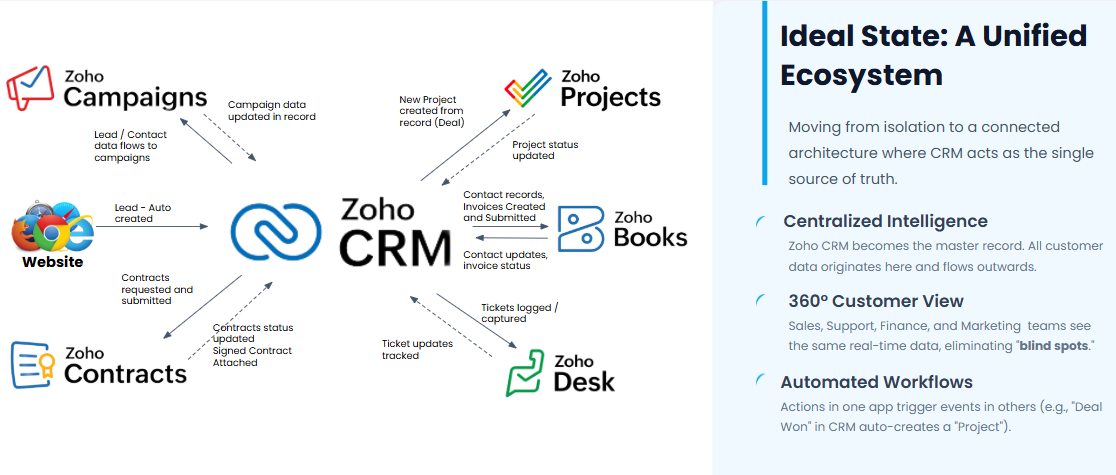
A design principle was established to govern the entire transformation: the CRM would become the centre of the ecosystem. It was the natural system of record for customer, prospect and commercial relationship data. Every other application would orbit it. Customer data would originate in the CRM and flow outward. That decision shaped every subsequent choice.
Before any configuration work could begin, the data had to be cleaned. The deduplication exercise was done manually and in full. Over three weeks, 93,000 duplicate and redundant leads, 8,000 duplicate contacts and 12,000 obsolete accounts were removed. 113,000 records in total. Integrations built on corrupted data would only propagate the problem.
With the data foundation restored, the CRM configuration was rebuilt from the ground up. The existing setup served only one business type. It was redesigned to support existing and potential new business types within a single CRM architecture, with differentiated layouts and workflows where required. Module forms were standardised. Lead sources, industry classifications and product interest fields were defined to support marketing strategy and lead scoring. Website inquiry forms were connected directly to the CRM to eliminate manual lead creation. Duplicate prevention logic was implemented across leads, contacts and accounts to ensure the problem could not recur.
With the CRM stabilised, integrations were built outward to operationalise the architecture. Closed deals automatically created client projects in Zoho Projects without manual handover. Account managers gained visibility into support tickets directly from customer profiles in Zoho Desk. Lead and contact data flowed automatically into Zoho Campaigns. Commercial agreements were managed from within the CRM through Zoho Contracts and Zoho Sign. Automated notifications across applications replaced manual follow-up through Zoho Cliq. Together, these integrations removed manual handoffs and established the CRM as the operational source of truth across the customer lifecycle.
The final stage was governance and control. The most significant risk identified was in Zoho Projects and Sprints, where all 200 users had administrator-level access to every project in the organisation. The RBAC model was redesigned and roles and permissions were reconfigured across all 12 applications, replacing unrestricted access with role-based control. Across People, Attendance and Leave Management was restructured and KRA and Goals management was configured with a Zoho Projects integration to map individual tasks to organisational goals. Field-level controls and ownership rules were established across the ecosystem to prevent teams from reverting to isolated configurations.