Redefining the Process Architecture.
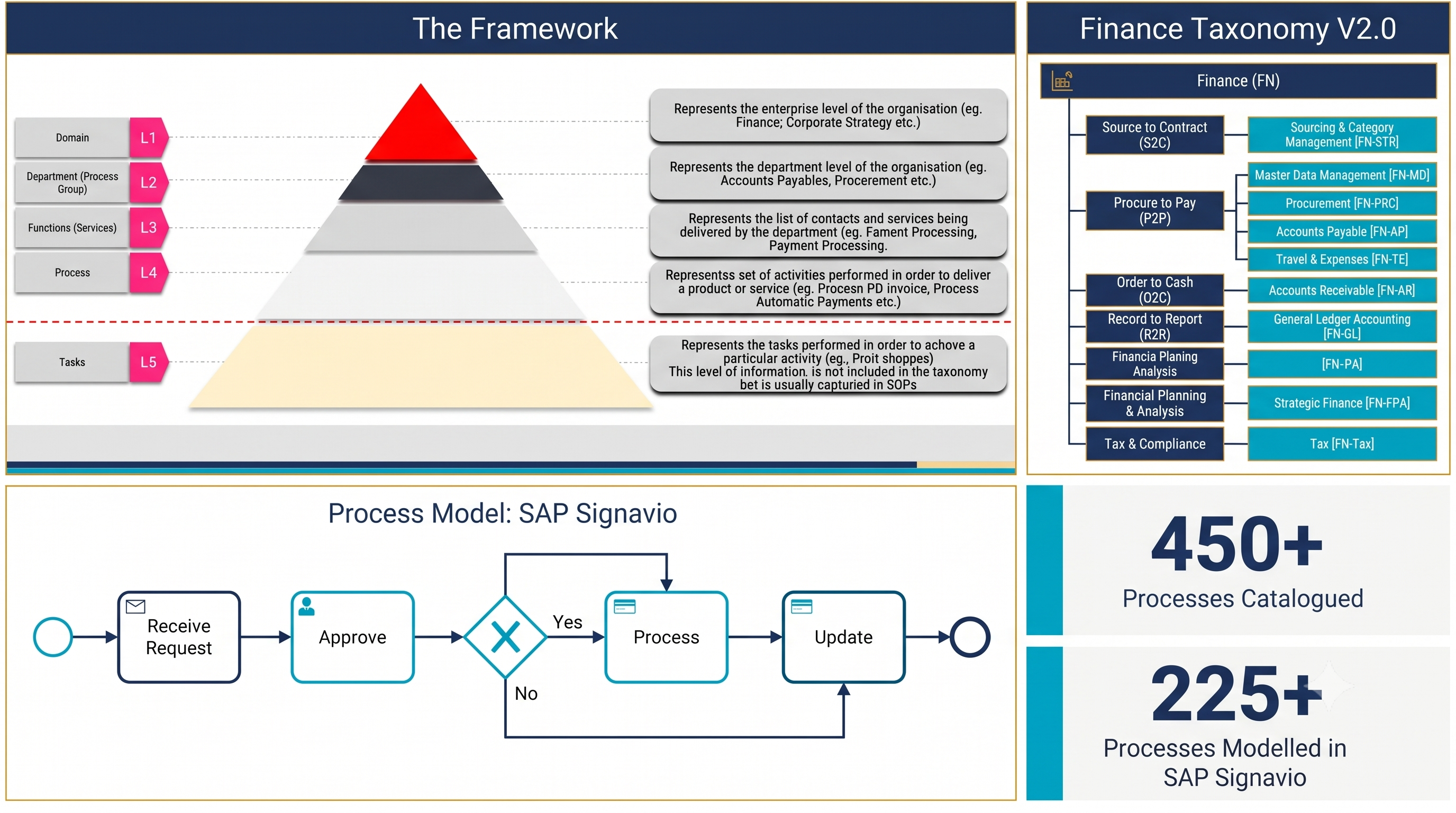
A leading management consulting firm had delivered a Finance Process Taxonomy for a fast-growing e-commerce organisation operating across APAC. The taxonomy was intended to serve as the definitive reference for how Finance processes were structured, owned and governed across 12 process groups.
When the organisation brought in a Business Process Management specialist to study and operationalise it, a fundamental structural flaw was identified. The hierarchy had not been maintained consistently. L3, L4 and L5 processes had been mixed across levels, breaking the logic that makes a taxonomy usable. Process owners could not reliably identify what they owned, where their processes sat in the hierarchy or how they connected to adjacent functions.
A taxonomy built on inconsistent levelling cannot serve as a governance framework. It had to be revised before any process improvement work could begin.
The consequences of a flawed taxonomy extend beyond documentation. When process ownership is unclear, resource allocation becomes guesswork. Demand forecasting lacks a reliable foundation. Process improvement initiatives cannot be scoped accurately because nobody agrees on what the process actually is or where it starts and ends.
Across 12 Finance process groups covering Procure to Pay, Order to Cash, Record to Report, Financial Controlling, FP&A and Tax, the organisation had over 450 processes that were theoretically catalogued but practically ungoverned. The consulting firm had delivered a document. What the organisation needed was a working framework.
The engagement ran in two phases.
The first phase was taxonomy revision. Drawing on prior experience designing and deploying Finance process taxonomies in shared service environments, the existing taxonomy was analysed against established hierarchy principles. The revision exercise identified inconsistencies across all 12 process groups and produced Finance Taxonomy V2.0 through a three stage process:
Stage 1 assessed completeness. Missing processes were identified through market visits and Finance Director consultation discussions. Stage 2 aligned process ownership. Each process group was reviewed with Local Finance Directors and Regional Process Owners to confirm accountability. Stage 3 finalised the L3 structure, aligned L4 processes to their correct functional groupings and obtained sign-offs from all Regional Process Owners.
The revised taxonomy took four months to complete. Eight types of changes were applied across the taxonomy: adding new processes, removing obsolete ones, merging similar processes, splitting complex ones, transferring ownership, creating new process groups, restructuring functional groups and realigning L4 processes to the correct L3 groupings.
The second phase was process modelling. The modelling engagement was led end to end. All 225+ processes mapped within the revised taxonomy were modelled in SAP Signavio with the appropriate process artefacts, risk and control assignments and system references. The modelling exercise ran for eight months. Three of the modelled processes were reviewed in depth for improvement opportunities. One of those reviews directly identified the gaps in the Collections and Dunning process that became a separate reengineering engagement.